

The competition’s highly anticipated People’s Choice Award, supported by lead corporate sponsor Nuveen, returns with 24 amazing wildlife images. The shortlisted photographs were chosen from 60,636 entries from 113 countries and territories in addition to the 100 winning images announced in October 2025. The judging panel included photography, wildlife, conservation and science experts.
The powerful line-up includes images celebrating the beauty and magnificence of the natural world as well as those highlighting environmental and conservation issues.
Voting is open until 18 March and the winner, along with four runners-up, will be announced on 25 March. Their photographs will go on display in the WPY exhibition at the Natural History Museum in London.
Here are some of our favourite images. See all 24 and vote for your winner here.

A Fragile Future
Lance van de Vyver (South Africa)
A pangolin pup nestles into the warmth of a blanket at a rescue centre in South Africa. Pangolins are among the world’s most trafficked animals. This baby’s mother was a victim of poaching and endured appalling conditions. But she was rescued and, against the odds, her baby was born. Shortly after, the mother died. This image shows both the resilience of life and the ongoing problem of the illegal wildlife trade.
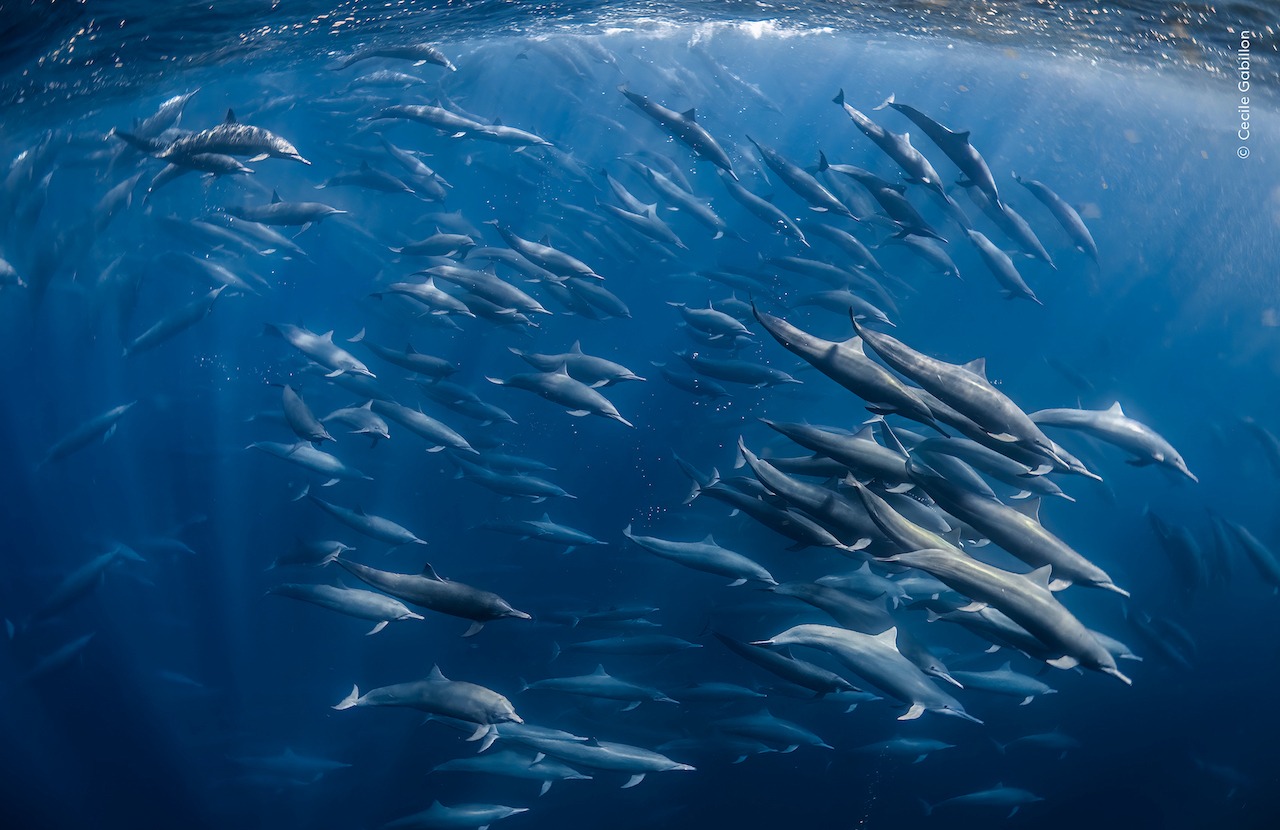
Swirling Superpod
Cecile Gabillon (France)
A spectacular superpod of spinner dolphins herds lanternfish towards the surface of the ocean. Cecile was free-diving in the Pacific Ocean, near Costa Rica, when she came across the dolphins. They were herding lanternfish and guiding them towards the surface. Cecile was swimming so hard to keep up with them that it was almost impossible to take pictures. And her fisheye lens wasn’t wide enough to take in the full scene. She says that being surrounded by these dolphins was one of the most amazing encounters of her life. As they welcomed her into their realm, she nearly forgot to come up for air. Sadly, pollution and overfishing are making these massive groups rarer.

The Final Portrait
Nima Sarikhani (UK)
A polar bear cub looks into the camera as it accompanies its mother on an unsuccessful hunting trip on the coast of Svalbard archipelago. Soon after the photograph was taken, the polar bear and its family went too close to an area of huts, and people forced them away. Not long after, the mother bear was found dead in the water near the shore. According to reports, she had died from serious internal injuries. Her cub was by her side. Police shot it dead because it seemed to be aggressive. This is likely the last image of the cub.

Family Rest
Christopher Paetkau (Canada)
A mother polar bear and her three cubs pause peacefully in the summer heat. The sun is high, the land wide and open. The polar bears rest after their long journey north along the Hudson Bay coast in Canada. Shrinking sea ice is making it harder for polar bears to hunt and find food to survive in summer. This is a story of endurance and a fleeting moment of hope in a world where survival is anything but certain.

Portrait of Extinction
Adam Oswell (Australia)
A mountainous pile of confiscated snares lies behind Uganda Wildlife Authority rangers. This huge pile consists of snares that had been confiscated over a one-year period in Murchison Falls National Park, Uganda. Adam joined several rangers and community volunteers to build it. They wanted to show the scale and urgency of the snare crisis in Africa. It took a week to build. Snares are an affordable and effective method of catching wildlife. Some communities use them because they’re in need of income and food security, but they’re also used by sophisticated poaching syndicates.

Beak-to-Beak
Ponlawat Thaipinnarong (Thailand)
A sarus crane shares an intimate moment with its one-week-old chick. Ponlawat watched the cranes and their chicks in the rice paddies in Huai Chorakhe Mak Non-Hunting Area in Buri Ram, Thailand. To avoid disturbing the birds, he would lay still for several hours a day while he watched. In the evenings, after the adults had fed their chicks, they rested on their nests. The parent of this one-week-old chick carefully cleaned it. Then, in a moment of intimacy, it made beak-to-beak contact with the chick.
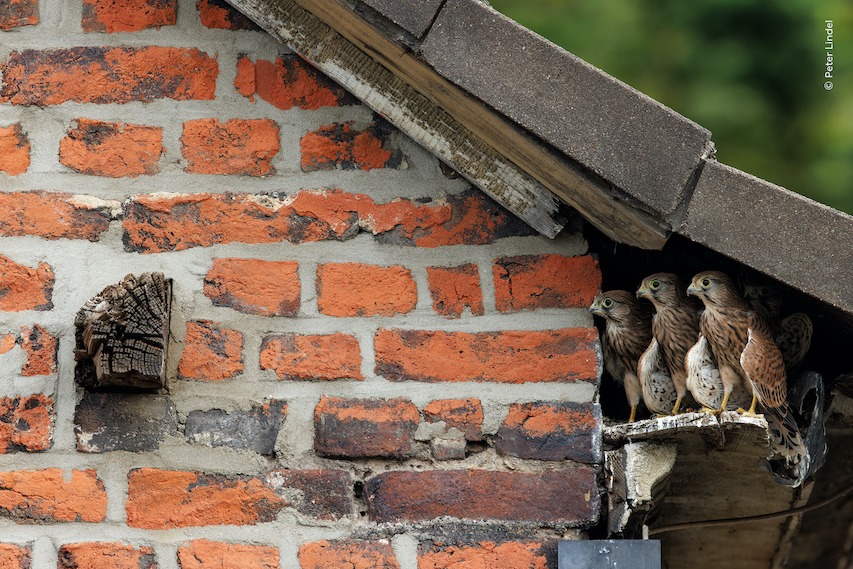
A Leap into Adulthood
Peter Lindel (Germany)
Three young kestrels prepare to leap from their nest to a nearby beam. From April to July 2023, Peter observed and photographed a pair of common kestrels. He witnessed moments from their courting until the time their young left the nest. He took this picture from his living room in Dortmund, Germany. It shows the moment when the young kestrels appear to be thinking about how to reach the beam, which was only 80 centimetres (31 inches) away. It took them nearly a week to pluck up the courage and take the leap. They then explored around the outside of his house for another week before leaving.

Never-ending Struggle
Kohei Nagira (Japan)
A sika deer carries the interlocked severed head of a rival male that had died after their battle. In autumn, male sika deer fight over females by clashing their antlers. This deer won the fight, but their antlers became tightly locked and wouldn’t come apart. A local fisherman says the deer dragged the whole body for several days before finally tearing off its head.
Kohei observed the deer on Notsuke Peninsula in Hokkaido, Japan, from late November 2020 to April 2021. It was living alone, yet it continued to forage for grass and branches and managed to survive the winter.
The image shows life and death bound together.

Bond in Motion
Lalith Ekanayake (Sri Lanka)
The striking eyes of a curious lion-tailed macaque and its infant are on display as it races along a path. Lalith was exploring the city of Valparai in the Western Ghats, India. He was surprised to come face to face with these macaques. The mother raced towards Lalith, both pairs of eyes gazing forward, full of curiosity. These are one of the most endangered species of macaques in the world. Human activity is eroding their habitat. Now, they survive in small, fragmented populations. For Lalith, this snapshot immortalises the macaques’ resilience in a world where their future is uncertain.
Wildlife Photographer of the Year is developed and produced by the Natural History Museum, London.